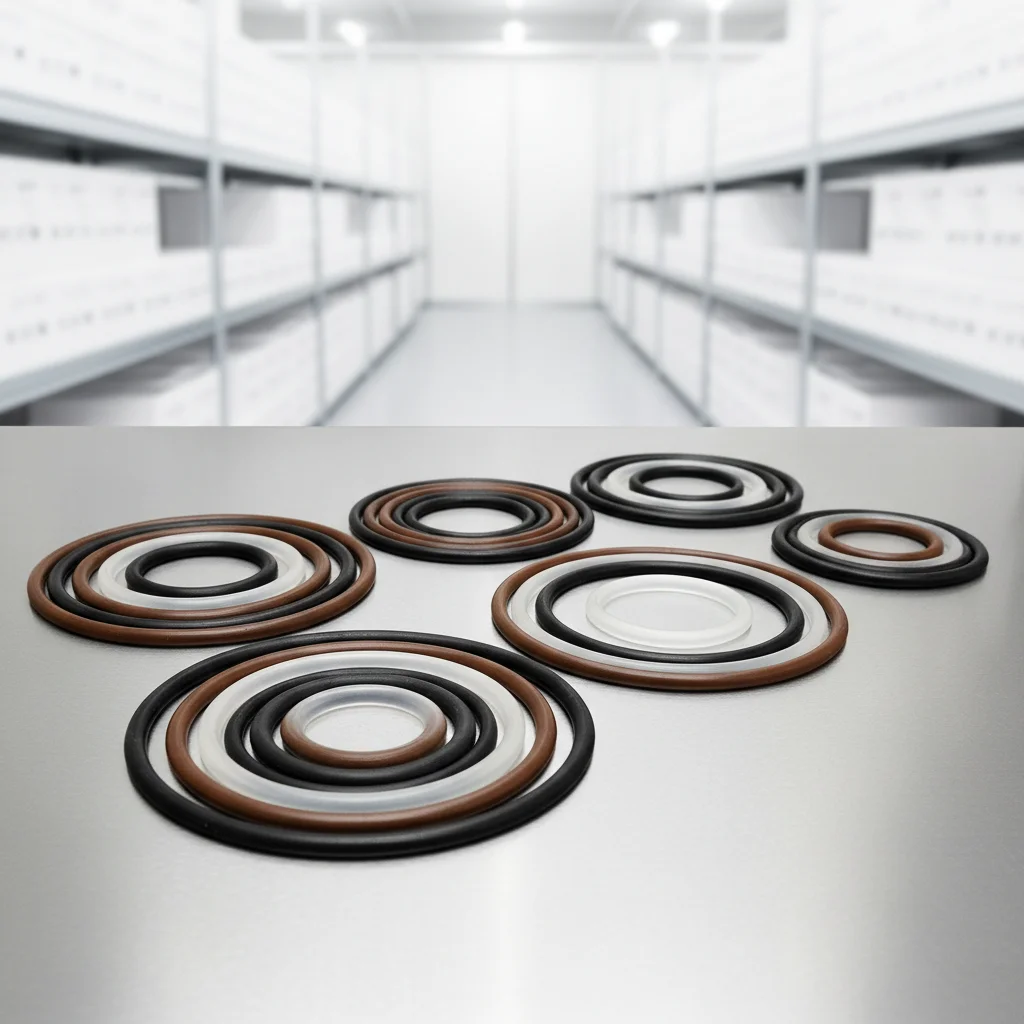
In complex industrial assemblies, the ability to distinguish between different sealing components at a glance is more than a convenience—it is a critical safety and maintenance requirement. Custom Colored O-Rings provide a visual coding system that eliminates installation errors and streamlines inspection processes across diverse engineering sectors.
While standard black rubber is the default for most applications, the strategic use of color allows engineers to differentiate materials, such as separating EPDM from NBR or Silicone, without relying solely on part numbers. This visual management strategy reduces downtime during overhaul and prevents the catastrophic failure associated with installing the wrong elastomer in a chemically aggressive environment.
Achieving this requires a precise balance between pigment integration and material integrity. The challenge for manufacturers is to provide vivid, stable colors that do not compromise the physical properties, such as tensile strength or compression set, required for high-pressure sealing.

The Strategic Role of Visual Coding in Sealing Systems

Visual identification through color is a primary lean manufacturing tool used to prevent "wrong-part" errors. In a single hydraulic manifold, there may be ten different O-rings of similar dimensions but vastly different chemical resistances. Without color, a technician relies entirely on documentation, which is prone to human error during fast-paced maintenance cycles.
By implementing a standardized color map—for instance, using blue for food-grade silicone and orange for high-temp FFKM—companies create a fail-safe mechanism. This visual layer of security ensures that the right material is matched to the right fluid, preventing premature seal degradation and potential environmental leaks.
Furthermore, color-coded seals assist in quality control during the assembly line process. Inspectors can instantly verify that the correct specification has been installed without having to disassemble the unit or use precision calipers to check for minute size differences.
Technical Trade-offs Between Coloration and Elastomer Performance
Adding pigments to a rubber compound is not a neutral process. The introduction of coloring agents can influence the cross-linking density of the polymer, potentially affecting the final hardness (Shore A) and the compression set of the O-ring. High-quality custom coloration requires the use of chemically inert pigments that do not react with the curing agents.
For materials like EPDM, which are often used in steam and weather-resistant applications, the pigment must be stable against UV radiation and heat. If the pigment is unstable, the seal may fade or "bleed" color into the surrounding medium, which can be a critical failure in medical or food-grade environments.
Professional manufacturers utilize internal laboratories to test the physical properties of colored batches against their black counterparts. This ensures that the wear resistance and oxygenated-solvent resistance remain within the specified tolerances, regardless of the visual appearance.
Critical Applications for Color-Coded Rubber Components
In the medical and food industries, color is often a regulatory or safety requirement. Food-grade silicone O-rings are frequently produced in blue or red to ensure high visibility; if a piece of the seal were to tear and enter a production line, the contrasting color allows for immediate detection and removal, preventing product contamination.
In the aerospace and defense sectors, color coding is used to distinguish between different pressure ratings or fluid types. A red seal might indicate a high-pressure hydraulic line, while a green seal indicates a low-pressure lubricant line. This prevents cross-contamination of fluids that could lead to system failure in flight.
Petrochemical plants utilize custom colors to manage the complexity of their valve arrays. By assigning specific colors to seals resistant to different acids or bases, maintenance teams can quickly audit the system's integrity and replace worn components with the exact material specification required for that specific chemical stream.
Comparing Maintenance Efficiency With Visual Identification
The primary value proposition of custom colored seals is the reduction of "mean time to repair" (MTTR). When technicians can identify a part visually, the time spent referencing manuals and verifying part numbers is significantly reduced, leading to faster turnaround times for critical machinery.
The following data illustrates the relative improvement in operational efficiency when transitioning from standard black seals (requiring manual verification) to a color-coded system (allowing instant identification).
Custom Colored O-Rings Performance Metrics
As shown, the most dramatic improvement occurs in "Installation Accuracy" and "Inspection Speed," where visual cues eliminate the ambiguity of similar-looking black parts. While the material performance remains nearly identical, the systemic efficiency of the maintenance process increases substantially.
Procurement Framework for High-Precision Colored Seals
When sourcing custom colored O-rings, procurement officers must look beyond the color sample. The critical focus should be on the consistency of the compound across different batches. A shift in pigment concentration can lead to variances in the Shore A hardness, which directly affects the sealing force in a gland.
Key evaluation criteria include the supplier's ability to match Pantone or RAL standards and their access to high-purity raw materials. For instance, using premium EPDM from suppliers like LANXESS ensures that the base polymer can handle the addition of pigments without losing its characteristic resistance to ozone and heat.
Furthermore, verify the supplier's quality management certifications. Systems like TS 16949 or ISO 9001 ensure that the process for pigment mixing and curing is documented and repeatable, minimizing the risk of receiving a batch with "marbled" color or inconsistent elasticity.
Evolution of Pigment Technology in Synthetic Rubbers
The industry is moving toward more advanced, inorganic pigments that offer superior thermal stability. Early colored rubbers often suffered from "scorching" or discoloration when exposed to temperatures above 120°C. Modern pigments allow colored EPDM and Silicone seals to maintain their hue even under prolonged steam exposure at 180°C.
There is also a growing trend toward "intelligent" coloration, where pigments are engineered to change color when the seal reaches a certain state of wear or thermal degradation. While still in the early stages of industrial adoption, this could potentially allow for predictive maintenance based on visual inspection alone.
Moreover, the push for environmental sustainability is driving the development of pigment-free visual identifiers, such as laser-etched codes on the O-ring surface. However, for most high-volume industrial applications, custom colored compounds remain the most cost-effective and reliable method for visual management.
Material Selection Guide for Custom Color Requirements
Selecting the right material for a colored seal involves matching the desired color with the operational environment. Not all elastomers accept all pigments equally, and some colors may be more stable in specific chemical environments than others.
The following table provides a decision matrix for selecting the appropriate elastomer based on common color-coding needs and industrial operating conditions.
| Material Type | Typical Color Use | Primary Environment | Key Limitation |
|---|---|---|---|
| Food Grade Silicone | Bright Blue / Red | Food & Pharma | Low Abrasion Resistance |
| EPDM | Yellow / Green | Steam & Outdoor | Poor Oil Resistance |
| NBR (Nitrile) | Brown / Blue | Oil & Fuel Systems | Poor Ozone Resistance |
| FKM (Viton) | Green / Brown | High Temp Chemical | Higher Material Cost |
| FFKM | Custom Rare Colors | Extreme Corrosives | Very High Cost/Unit |
| Encapsulated | White / Translucent | Ultra-Pure Water | Lower Elastic Recovery |
For organizations requiring a tailored solution, reviewing the technical capabilities available at www.beikesealing.com can provide insights into how specific formulas can be optimized for both color stability and mechanical performance.
Frequently Asked Questions
Conclusion
Custom Colored O-Rings are more than an aesthetic choice; they are a strategic engineering tool that enhances safety, reduces human error, and accelerates maintenance cycles. By integrating visual coding into the design phase, companies can significantly lower the risk of material mismatch and improve the overall reliability of their fluid sealing systems.
The key to success lies in partnering with a manufacturer capable of balancing pigment stability with rigorous material standards. For those evaluating the transition to color-coded systems, the technical data and product range available at www.beikesealing.com offer a comprehensive starting point for implementing these efficiency gains.